
One box, not five
Inverter, solar charge controller, AC charger, breakers and displays come pre-wired inside one cabinet. You don't need a wall of separate components or a separate battery room.
FES-20 Outdoor Power Cabinet
A 20 kW split-phase inverter, 21 kW of MPPT solar charging and a 14 kW AC charger, all in one outdoor enclosure. It's built to run directly on used Tesla Model 3 and Model X battery packs at 400 V.

Inverter, solar charge controller, AC charger, breakers and displays come pre-wired inside one cabinet. You don't need a wall of separate components or a separate battery room.
An IP54 steel enclosure with a rain hood, gasketed locking door and filtered fan cooling. Our units have been running outdoors under the array since 2023.
The DC bus is native 400 V, the same voltage as a Tesla Model 3 or Model X pack. There's no repacking or DC-DC converter in between, and a 75–100 kWh pack connects directly.
A low-frequency isolation transformer and 150% surge capacity start well pumps, compressors, shop tools and HVAC that would trip a lighter high-frequency inverter.
Show & Tell
Tap a numbered marker to see what each part of the front panel does.

A powder-coated steel cabinet with an overhanging rain hood keeps water off the door seam. It sits on a pad, a skid or casters.
Takes high-voltage PV strings up to 700 VDC and charges the 400 V pack directly. A color display shows array voltage, current, power and daily harvest.
Charges the pack from grid power or a generator. On a cloudy week, a generator can put meaningful energy back into the pack quickly.
Shows charging state, DC bus voltage and current, and lets you set charge limits for the pack chemistry.
Shows output voltage and frequency on each leg, load in kW, AC input status and fault codes. Settings are adjusted from the front panel.
Each power path has its own labeled breaker: PV input, battery, AC output, AC input and DC loads. Any subsystem can be isolated in seconds.
One clearly labeled terminal strip for battery, PV, AC input and the L1/L2/N output to your panel. Cables enter from below through sealed glands.
Louvered intake in the door with temperature-controlled fans. Rated to operate from −4 °F to 122 °F.
How it works
FES-20 Cabinet
Why 400 V Tesla packs
Wrecked and retired Model 3 and Model X vehicles leave behind battery packs with tens of thousands of miles of life left in them. These are liquid-thermal-managed automotive packs, often 75–100 kWh each, and they cost a fraction of new stationary storage.
Most off-grid gear runs at 48 V, which means a Tesla pack has to be torn down and rebuilt before it can be used. The FES-20 skips that step. It's designed around the pack's native ~400 V system, so the pack stays sealed and intact.


Assumes a 90% usable window and ~93% inverter efficiency. A typical U.S. home averages about 1.2–1.5 kW.
Freedom Battery Interface
A used Tesla pack shouldn't be a mystery box. The Freedom Battery Interface connects to the pack's own brain, the Tesla battery management system, and puts everything it knows on a simple web page. Pull it up on your phone from the kitchen table.
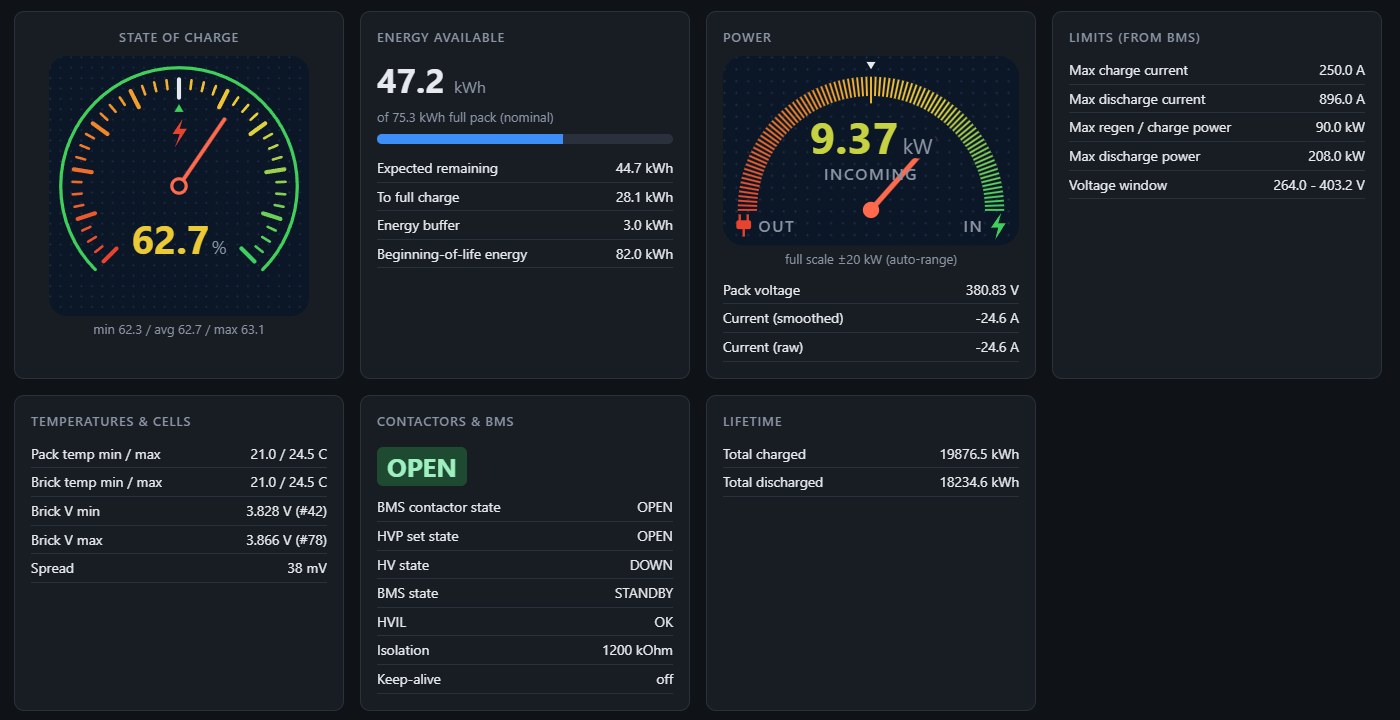
How full is the battery? How many kWh are left? Is power coming in from the panels or going out to the house? The Overview answers all of it in about a second.
The fuel gauge shows state of charge. The power dial swings right when you're charging and left when you're using power. The side panel shows the limits the pack itself reports, so you always know how hard you can push it.
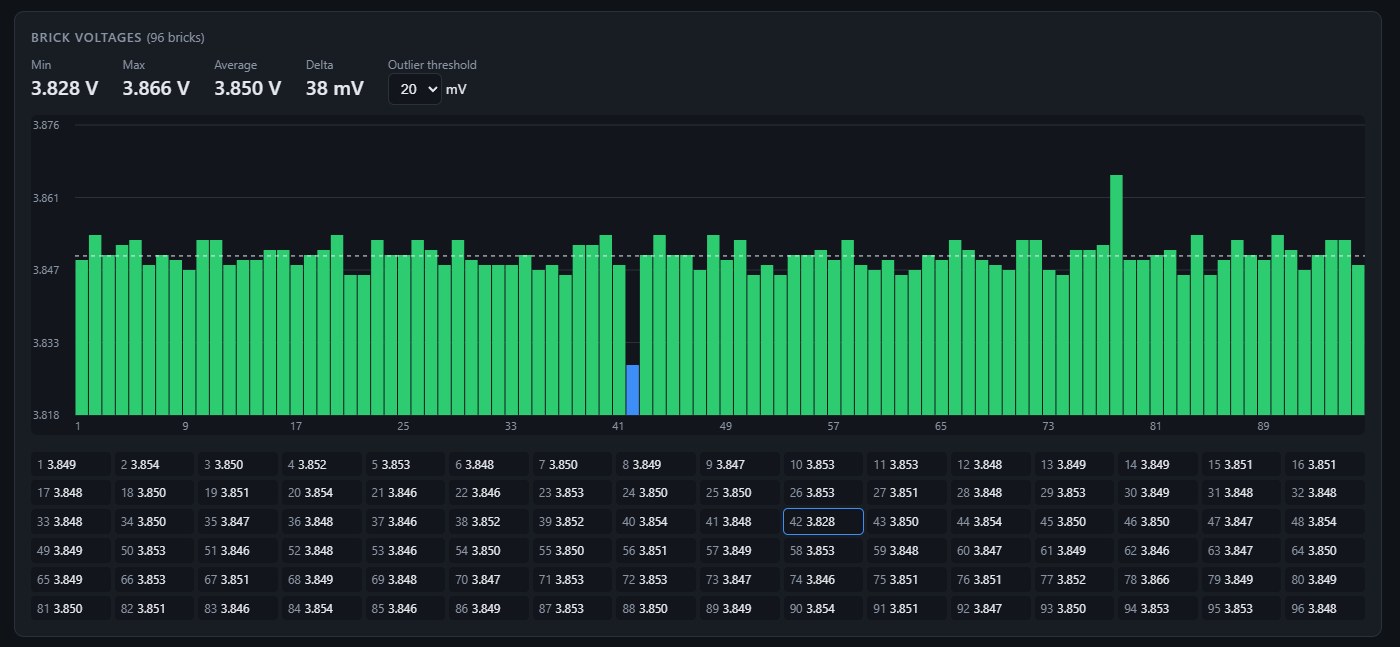
A Model 3 pack is built from 96 groups of cells connected in a chain, and a battery is only as good as its weakest group. The Cells page shows every one of them.
Healthy groups line up like a picket fence. One that's drifting low sticks out right away, like #42 in blue here. Catching that early can be the difference between a simple fix and a dead pack.
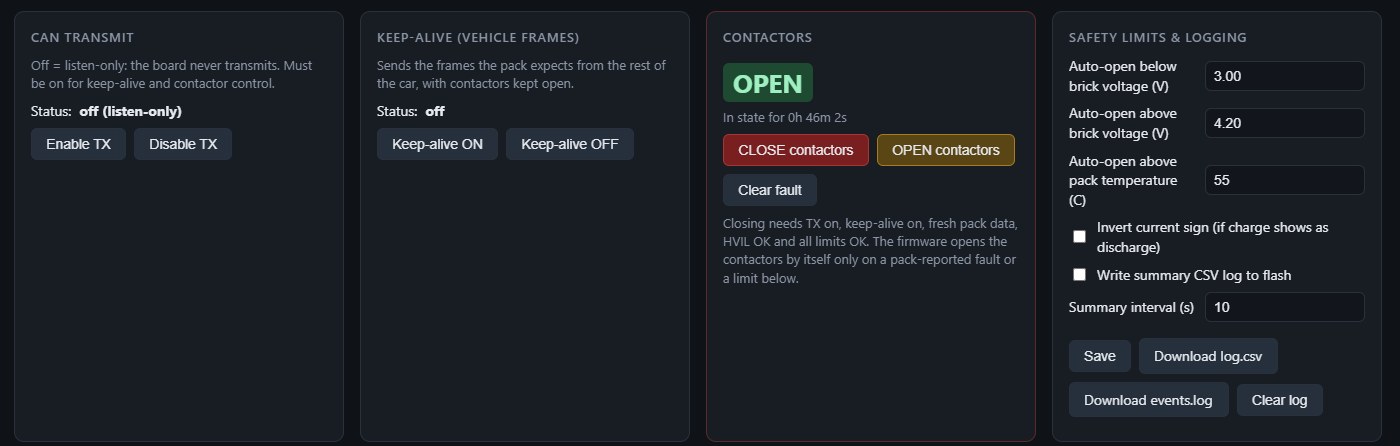
The interface runs the pack's contactors, the heavy-duty relays that connect the battery to the cabinet. It won't close them unless the pack is talking, its safety loop is intact and every limit is in range.
If any cell group goes too low or too high, or the pack gets too hot, it disconnects the battery on its own. You choose the thresholds; ours ship at 3.00 V, 4.20 V and 55 °C.
Listen-only mode reads a pack without ever switching it on, so you can see its cells and capacity before you commit.
New features install wirelessly, with no laptop trip to the shed. Updates are blocked while the battery is connected.
Your dashboard sits behind a login, so only you can see the controls or change settings.
An event log and downloadable data history show what the pack has been doing while you were away.
Screenshots from the live dashboard running in demo mode.
Specifications
Typical configuration. Final settings are matched to your battery and array at order time.
Specifications subject to change. High-voltage DC systems must be installed by a qualified electrician in accordance with local code.
In the field since 2022
Every photo here comes from a real install on a working homestead.
Who it's for
Full 120/240 V service for the whole house, the well and the shop, with no utility in the picture.
Keep the lights, freezer and well running through multi-day outages, with generator charging as a backstop.
Low-frequency transformer muscle for compressors, welders, saws and pumps.
One outdoor cabinet and one sealed pack. There's no battery room to build and no wall of gear to fit inside.
Finally a turnkey home for that salvage Model 3 or Model X pack sitting in the garage.
A repeatable, single-cabinet system that's quicker to wire and easier to explain to customers.
FAQ
No. The FES-20 is an off-grid / backup power center. Grid power or a generator can connect to the AC input to charge the battery and pass power through to your loads, but the cabinet does not export energy to the utility.
The system is designed around the 96-series ~400 V packs used in the Tesla Model 3 and Model X. Other 400 V-class lithium batteries can be accommodated by arrangement. Tell us what you have and we'll confirm compatibility.
No. The pack stays sealed. Power connects through the pack's high-voltage connection, and the Freedom Battery Interface connects to its low-voltage harness to monitor and manage it.
Yes. The Freedom Battery Interface joins your home WiFi and serves a password-protected dashboard to any phone, tablet or computer. It shows charge level, kWh left, power in and out, temperatures and every cell group, and it lets you adjust the safety limits.
Yes. That's what the low-frequency isolation transformer is for. The inverter handles 150% of rated output for 10 seconds, which covers the inrush of typical deep-well pumps, compressors and HVAC equipment within its 20 kW rating.
Yes. The cabinet is IP54-rated, with a rain hood, gasketed door and fan cooling, and is rated from −4 °F to 122 °F. The units in our photos have run outdoors under the array since mid-2023.
Up to 21 kW of PV through the built-in MPPT controller, with strings up to 700 VDC. We'll help you lay out strings so their cold-weather open-circuit voltage stays under that limit for your panels and climate.
This is a high-voltage DC system and should be installed by a qualified electrician to local code. We provide wiring documentation and work with your installer.
Pricing and lead time depend on configuration and current build schedule. Send a quote request and we'll get back to you with current numbers.
Get a Quote
Tell us about your property, your loads and the battery you have or plan to buy. We'll get back to you with a configuration and price.